

Digitalization of Business Processes: Where and How to Start
- Topics of this post
Companies often already use various digital tools, but these do not necessarily function as a connected whole. Data remains dispersed, and employees still have to perform many tasks manually. Therefore, successful digitalization is not merely a question of deploying new software, but above all of thoughtfully aligning business needs and technology.
The challenges of digitalization are not solely technological. According to the Statistical Office of the Republic of Slovenia, in 2025 as many as 56% of enterprises with at least 10 persons employed cited a lack of suitable staff or skills as a barrier to digital transformation. This shows how important it is to factor in available competencies and professional support when planning digitalization.
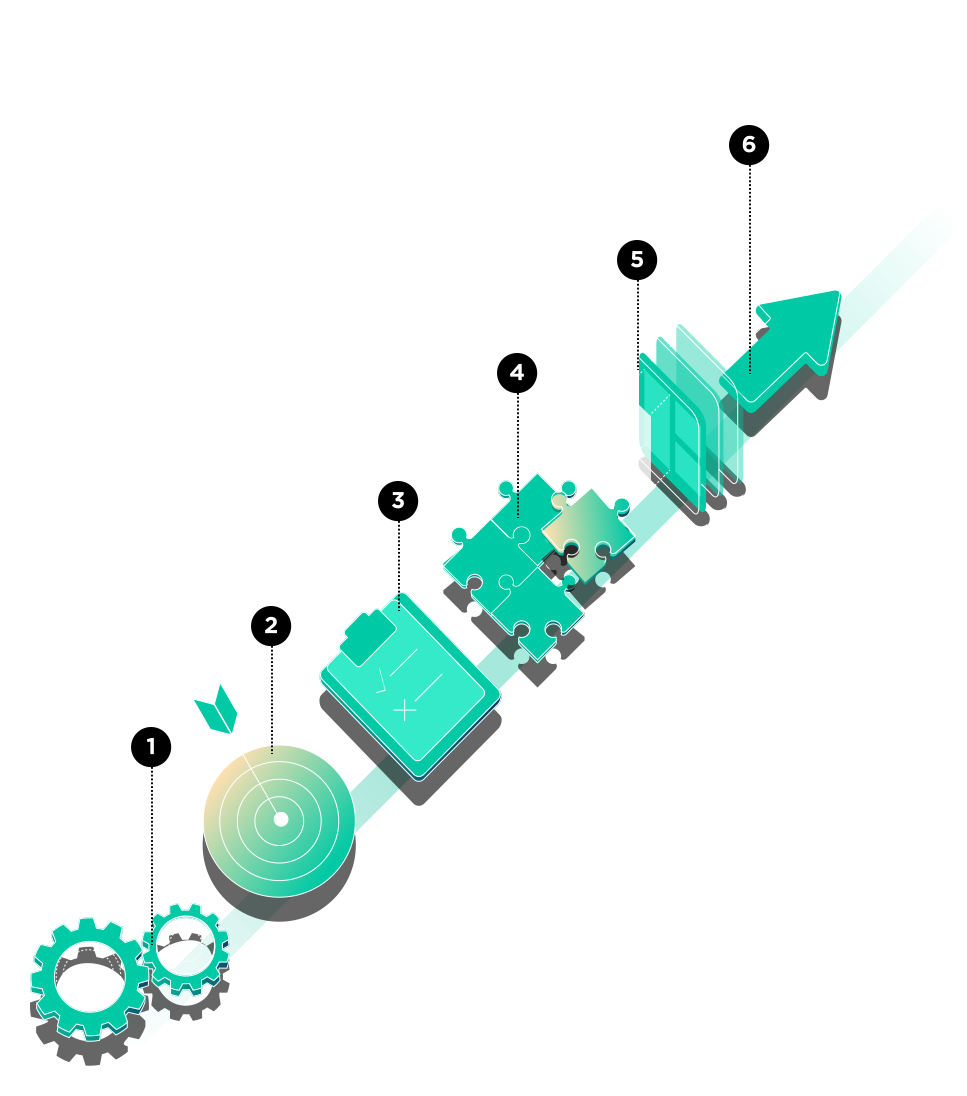
So how should digitalization be approached in practice? We present six steps that help a company move from the initial analysis to the successful rollout of digital solutions.
What is the digitalization of business processes?
The digitalization of business processes means using digital technologies to improve how a company performs its day-to-day activities. Its aim is to streamline work, reduce the amount of manual tasks, and enable a more efficient flow of information among employees, departments, and information systems. This also makes it easier for the company to manage business processes by providing better visibility into workflows and timely access to the data needed for decision-making.
It is important to distinguish between four related concepts:
| Term | What it means | Example in order processing |
|---|---|---|
| Digitalization | The process runs with the support of digital tools | The order flows directly into the business system |
| Automation | The task is executed automatically | The system confirms the order on its own and sends it to production |
| Optimization | An improved way of working | An unnecessary approval step is eliminated |
| Digital transformation | A change to the business model enabled by technology | A new model with next-day delivery (Della Spina example) |
The difference can be illustrated with an order-processing example. A company that receives orders by email and manually re-enters them into the business system is already using digital tools, yet the process still requires extensive manual work. With digitalization, orders can flow directly into the business system; with automation, they can be processed automatically. Optimization also includes reviewing the entire procedure and removing unnecessary steps. When a company connects such changes within a broader renewal of its operations, we speak of digital transformation. This does not only improve individual processes, but can also involve changing the way of doing business, the service offering, or the business model.
How to Approach Digitalization in Six Steps?
- 1 Which business processes make sense to digitalize
- 2 How to define digitalization objectives and priorities
- 3 How to assess existing information systems
- 4 How to choose the right digital solution and plan its rollout
- 5 How to successfully implement digital solutions and engage employees
- 6 What to do after deploying a digital solution
1. Which business processes make sense to digitalize?
It makes the most sense to digitalize processes that are highly repetitive, require extensive manual work, or are prone to errors and delays. To identify them, the company must first review how the work flows end to end, who is involved in individual tasks, and which information systems support them.
It is advisable to involve employees who execute the processes every day in the analysis. They know best where unnecessary manual work, data duplication, or delays occur. It is also important to review the connections between departments, as a process that works well in one department may cause issues elsewhere.
Signs that a process is suitable for digitalization: the same data are entered in multiple places, the process relies on email, paper, or Excel spreadsheets, frequent errors occur when rekeying data, the process stalls when a key person is not at work, there is no real-time visibility into the stage of an order or request.
Step outcome: a review of the current state and a list of processes where digitalization would deliver the greatest benefits.
2. How to define the objectives and priorities of digitalization?
The company defines the goals of digitalization based on the specific issues identified in the analysis and documents them so that they are measurable. The goals must stem from business needs, not from a desire to introduce a new technology.
Example of a measurable goal: instead of “improve order processing,” it is better to state “reduce order processing time from two working days to four hours” or “reduce data entry errors by half.” This makes it clear after implementation whether the change delivered the expected impact.
Because it does not make sense to digitalize all processes at once, priorities must be set. Three questions help: what is the process’s impact on the business, how complex is the redesign, and what benefits can the company expect. A good starting candidate is a process with high impact and relatively low complexity.
Step outcome: measurable goals, the process selected to start with, and a clearly defined scope for the first phase.
3. How to assess existing information systems?
The company assesses existing information systems by checking which functionalities they already provide, how they exchange data, and whether they can support the defined goals. Only then is it clear whether an upgrade, integration of systems, or a new solution is needed.
Companies often use several separate systems, such as ERP, CRM, accounting software, an online store, and an inventory management system. If these systems are not connected, employees must transfer data manually or enter the same information in multiple places.
Questions for assessing existing systems:
Which systems does the company use and for which tasks?
Is data transferred between systems automatically or manually?
Do the systems enable integration with other solutions, for example via an API?
Are the systems still supported, secure, and regularly updated?
Are there technical constraints that would complicate future upgrades?
Digitalization does not always require replacing existing systems. Often, their upgrade or integration is sufficient, and a new solution makes sense when the existing system technically limits further development.
Step outcome: a decision on whether the company will upgrade existing systems, connect them, or implement a new solution.
4. How to choose the right digital solution and plan its rollout?
The company selects the right digital solution based on business objectives, analysis findings, and technical requirements, not on the popularity of a particular tool. The solution must address current needs and allow adaptation to future business development.
Criteria for selecting a solution:
functionalities that support the defined goals,
connectivity with existing systems,
security and reliability of operation,
long-term costs of use, maintenance, and upgrades,
the ability to scale as the company grows.
Once the solution is selected, an implementation plan follows. It defines the project scope, accountable roles, required resources, timelines for each phase, and potential risks. You also need to define how key business processes will operate during the rollout.
For larger projects, we recommend a phased implementation: start with a pilot process or a single department, then expand to the rest. This allows the company to validate key functionalities, fix issues, and reduce the risk of disruption to operations.
Step outcome: a selected solution and an implementation plan with scope, responsibilities, and timeline.
5. How to successfully implement digital solutions and engage employees?
A digital solution is only successfully implemented when employees actually use it in their daily work. Therefore, employees must be involved already in testing, not only at go-live. Users often uncover issues that technical tests do not reveal.
During implementation, follow the plan, continuously validate the solution in the business environment, and resolve issues in time to minimize their impact on critical processes.
Pre-go-live checklist:
key functionalities have been tested,
data migration from legacy systems has been verified,
integrations with existing systems work,
the employees who will use the solution have tested it,
training has been delivered,
a contact person has been designated for employees to turn to in case of issues.
Step outcome: a working solution in daily use and employees who know how to use it.
6. What to do after deploying the digital solution?
After deployment, the company must regularly check whether the solution is meeting the defined goals and enhance it based on findings. Some issues surface only in regular use, so employee feedback should also be monitored.
Indicators worth tracking:
process execution time before and after implementation,
number of manual steps,
number of data processing errors,
share of orders or requests processed automatically,
employee satisfaction with the new way of working.
Example: if the goal was to shorten order processing to four hours, the company checks the actual average time after three months. If the goal is not met, determine in which step the process is still stalling.
Step outcome: an assessment of the effects of digitalization and a plan for further improvements or the digitalization of the next process.
Digitalization in practice: two concrete projects
The digitalization of business processes varies considerably from company to company. Some want to automate individual procedures; others need better connectivity of existing systems or a redesign of the entire digital architecture. What matters is that the solution is driven by specific business needs.
Della Spina
From order to eyeglass production without manual intervention
Della Spina is a Slovenian optical brand that enables customers to try three pairs of prescription glasses at home for free and keep only those that suit them. The challenge was to establish an efficient business model that allows for fast order processing and company growth without a proportional increase in headcount.

The solution is based on integrating the online store with a glasses configurator and the Odoo ERP system. Data from the online order is automatically passed on for further processing, eyeglass production, and dispatch. A connected, paperless process reduces the need for manual intervention and enables more efficient order execution.
The results are reflected in fast order processing and the success of the sales model. Della Spina ships most orders within two business days. As much as 25 % of customers buy two pairs when trying three, and an additional 5 % buy all three.
Terme Olimia and Terme Tuhelj
Connecting two destinations into a unified digital platform
Terme Olimia in Slovenia and Terme Tuhelj in Croatia are established thermal and wellness destinations for which we have been developing and enhancing digital solutions for many years. As new services and features were developed, the digital ecosystem became increasingly complex, and the existing architecture was less and less able to support further enhancements.

The challenge was to connect the digital services of both destinations into a reliable and adaptable whole and to simplify their further development.
The solution is a shared digital platform that connects bookings, online sales, the loyalty program, and other guest services. The redesigned architecture enables more independent development of individual business domains and automatic adjustment of the infrastructure to workloads. Guests can also combine services from both destinations in a single purchase.
The digital ecosystem records two important results:
+20 % growth in gift voucher and ticket sales compared to the same period in 2025.
Approximately 80 % of guests use online check-in, which has become an established part of the digital customer journey.
What are the most common mistakes in the digitalization of business processes?
Even a well-planned digitalization of business processes can run into issues if the company overlooks certain key factors during implementation. Common mistakes include:
How to choose the right partner for digitalization?
When selecting a partner for the digitalization of business processes, in addition to technical expertise, experience in understanding business needs and integrating different information systems is important. The provider must understand the constraints of existing solutions and propose an approach that fits the company’s objectives and operating model.
It is also important to check their references, the way of collaborating on planning and implementation, and options for long-term support. Digital solutions often evolve together with the business, so it makes sense to choose a partner who can also provide maintenance and further upgrades.
Read more about business process optimization
Frequently asked questions and answers
Can a company obtain co-financing for digitalization?
Companies can obtain financial support for digitalization projects through public calls and other incentives, including the Slovenian Enterprise Fund. Funding options depend on the size of the company, the type of investment, and the terms of each call, so it is necessary to check which calls are currently open and which costs they cover.
How digitalized are Slovenian companies?
According to the Statistical Office of the Republic of Slovenia, in 2025 66 % of small and medium-sized enterprises in Slovenia achieved at least a basic level of digital intensity. In 2023 this share was 50 %, while the goal of the European Digital Decade programme is for 90 % of SMEs to reach this level by 2030. The data point to progress, while also indicating opportunities for further development of digital business.
Source: SURS, Digital Entrepreneurship, detailed data, 2025
How many Slovenian companies use ERP systems?
In 2025, 35 % of Slovenian companies with at least 10 employees and self-employed persons used an ERP software solution. Among small companies the share was 28 %, among medium-sized 67 %, and among large 97 %. The differences show that the use of comprehensive business systems is strongly linked to company size. Digitalization does not necessarily require a new ERP system, as connecting existing tools can also be an appropriate solution.
Source: SURS, Digital Entrepreneurship, detailed data, 2025
How many Slovenian companies use data for business analytics?
According to SURS, in 2026 37 % of Slovenian companies with at least 10 employees and self-employed persons carried out data analytics, up from 31 % a year earlier. Advanced data analytics, also used for forecasting and process optimization, was performed by 9 % of companies. This indicates that companies still have considerable scope to better leverage data for business planning, performance monitoring, and decision-making.
Source: SURS, Digital Entrepreneurship, 2026
How widespread is the use of cloud computing among Slovenian companies?
In 2026, 55 % of Slovenian companies with at least 10 employees and self-employed persons used paid cloud computing services, up from 48 % a year earlier. Cloud services enable companies to use business applications, store data, and access information infrastructure without the need to set up all systems on their own equipment. When selecting such solutions, it is necessary to consider business needs, security requirements, and options for integrating with existing systems.
How to get started in your company?
In digitalization, it is important for the company to first clearly define its needs and opportunities for improvement. This enables planning solutions that support its business objectives and further development.
If you are considering digitalization or a redesign of existing processes, we can help assess improvement opportunities and identify suitable technology solutions.
Schedule an introductory discussion in which we review one of your processes together and assess where digitalization would bring the most.
About the authors


Services of this post
Related Case Studies


Related posts

Domen Česnik
Humanfrog has been named among the Future 100 Slovenija, one hundred Slovenian companies with strong potential for further growth and international development. For us, this is an important recognition of our work to date and a confirmation that we are on the right track. At the same time, this inclusion gives us additional momentum for the future. It encourages us to continue developing, strengthen our expertise, and create advanced technological solutions that deliver long-term business value to our clients.

Matej Vidmar
Proxmox VE is increasingly used in more demanding production environments, so the question of how to protect such environments effectively is becoming ever more important. Backing up virtual machines is only one element. In practice, reliable replication, fast recovery, the ability to migrate across platforms, and proper access and infrastructure management are equally important.

Domen Česnik
Before going on vacation, we check whether we have documents, access to the bank account, copies of reservations, and insurance. We less often check whether our company also has a "backup plan" for its digital life. Where is its data stored? Who has access to it? Can we move it elsewhere? And would we be able to operate if a key provider suddenly became unavailable?

Matjaž Tomažič
Imagine a completely ordinary situation. You step into an elevator; in front of you is a panel with floor numbers. Do you know how to use it? Of course you do. And that is exactly why today I am writing an ode to the elevator—the simplest user interface. The elevator’s user interface, if those few numbers can even be called that, exhibits the highest possible degree of intuitiveness—a quality for which almost no prior learning is required.

Domen Česnik
A multilingual website had been on our task list for a year and a half, but we never found the right time for it. Client projects, infrastructure, development, and other day-to-day commitments always took precedence, so implementation of the English version of the website kept getting pushed back. The issue was not a lack of content or expertise, but the process, which required too much time and coordination. We only found a solution once we integrated translation into our existing publishing process.
