

Digital projects: more than communication, more than IT
Do you still remember, comrades
I fell into advertising quite by accident, at a time when roadside billboards were rare, print ads were the most widespread form of advertising, and television still had an economic propaganda program. When they introduced me to the work of an advertising agency, I could not imagine everything they did, let alone what my role would be. But it sounded appealing, and as a student I quickly found my footing in the new environment.
Three decades have passed since then. I spent most of those years in various advertising and communications agencies, where I quickly swapped the role of copywriter for that of manager and later project director.
At first, everything was analog. We delivered print ads to media companies on graphic films, only later on external drives. We did have the internet, but it took some time before we could start uploading ads via FTP to media servers.
At that time, it was mainly technologically advanced domestic companies and corporations that had their own websites. But shortly before the year 2000, the Slovenian digital landscape began to change rapidly. The first Slovenian-language search engines and portals emerged, enabling digital advertising. Ads were static, reached roughly a quarter of the population, and users were primarily young, urban, and tech-savvy. In 1999, we got the first domestic online store, which showed that the web could be linked directly to sales.
The evolution of online advertising
Rapid development brought the internet to half of Slovenian households by 2007, and if not earlier, it became clear to advertisers then that online advertising was becoming something that could no longer be ignored.
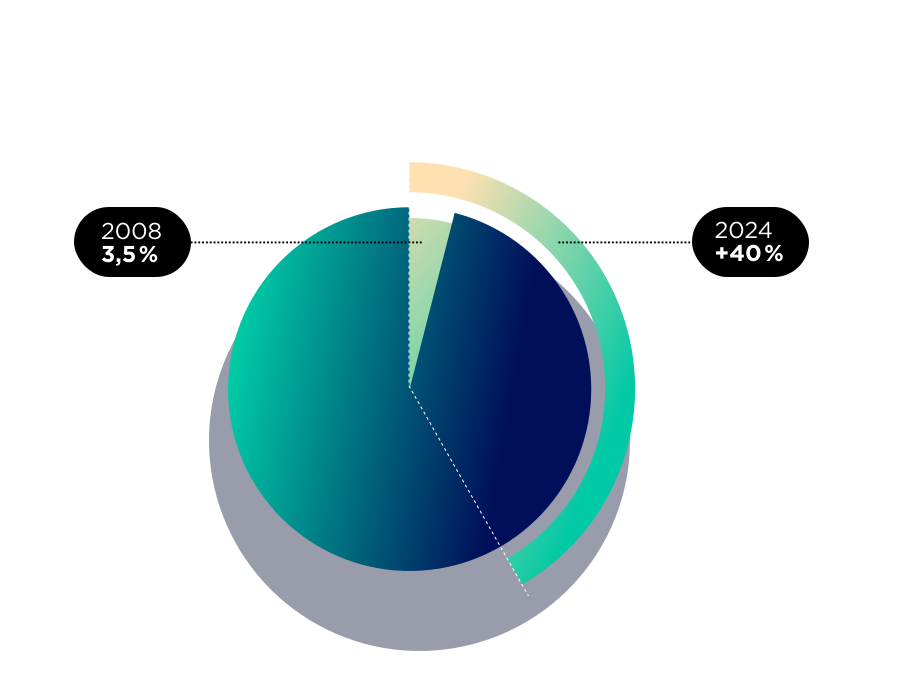
The web evolved into a new mass media environment that had to be treated on par with television, print, and radio. Ad formats evolved ever faster, and online advertising became measurable. And yet, as late as 2008, the digital segment here accounted for only around 3.5% of the total advertising market. For comparison: last year it exceeded 40% (Source: AdEx Report 2024, IAB Slovenia).
First steps into the digital age
I attended my first trainings that included the web in 1995, and at the time more or less everything was new to me. At the agency we followed developments, admired the first web campaigns of foreign partners, but it still took some time before we had our first client who understood the growing power of the web.
Advertising agencies that started to appear here in the waning days of socialism were organizations that helped companies not only with advertising, but also in shaping an integrated communications strategy, building brands, and understanding the market. Agencies were among the first to recognize the potential of online advertising.
A key advantage of agency people was that they knew how to listen to clients, understood them well, and, thanks to the trust they enjoyed, could more easily persuade them to adopt new communications tools, whereas the geeks who could actually build it mostly lacked the skills and capabilities to 'sell' their knowledge to companies. Thus, agencies most often served as the bridge between innovative technology and clients' business objectives.
With development, things changed
At first, a basic understanding of the web was enough, as online advertising was fairly simple, too. But as the digital ecosystem grew, things changed rapidly. New formats, new platforms, and increasingly complex tools for measuring results appeared. Consequently, the first digital departments and specialists who dealt exclusively with web projects began to emerge in agencies.
As the web evolved, client expectations naturally rose, and they were soon no longer satisfied with simple websites. For the creation of more complex websites, online stores, and advanced solutions, the knowledge and experience of agency teams eventually were no longer sufficient. The process consequently became fragmented and lengthy, with numerous communication breakdowns, as information moved from the client to the agency, then to external vendors, and then back along the same path.
Some technology companies quickly realized that with a different profile of people than they had employed until then, they could reach clients and win business directly. In addition to classic developers, they needed people who understand user experience, digital strategy, and clients' business objectives. New forms of collaboration and competition began to appear on the market.
Technology companies that recognized the opportunity and adapted became key partners to businesses in their digital breakthrough, as without intermediaries they were able to introduce innovative web solutions faster and more efficiently. This enabled the companies they worked with to make an easier transition into the digital environment and to create a direct link between strategy, development, and market communications.
The intersection of reliable technology and the power of communication
During that period, I was also working at an agency specializing in digital marketing. Large clients understood well the benefits of a considered online presence. In terms of communications projects, our support was reliable, and our proposals for incorporating state-of-the-art technological solutions that were attractive to target groups were comparable to those elsewhere in the world. We received awards at festivals. The gap began to appear with complex web projects.
Advanced projects require stable platforms, powerful databases, and integration with various external systems. In addition, important aspects include the protection of personal data, ensuring cybersecurity, compliance with legislation, and the ability to scale solutions for long-term growth.
If in the past the main requirement for a website was quick responsiveness and an attractive presentation, over time the requirements shifted to questions such as: How to protect user data? How to ensure uninterrupted operation with several thousand concurrent users? How to prevent outages that would jeopardize operations and trust?
Answers to these questions require not only knowledge but also time. Communications and marketing agencies chronically lack it. Everything should have been done yesterday, preferably the day before yesterday. And just as geeks once lacked the ability to listen to and understand clients, today agencies lack an understanding of the development of advanced technological projects.
After many years in advertising and communications agencies, I joined a fast-growing high-tech company. The experience and insights I have help me understand clients, and an awareness of the complexity of developing advanced projects allows me to understand projects end-to-end: from designing effective communication to technical execution and long-term sustainability.
Today I see the greatest value for clients precisely in the interweaving of two worlds: the creativity of marketing and the reliability of technology. Digital projects are no longer just a communications channel or a technical solution, but are becoming a fundamental strategic platform of the company. They are expected to build brand recognition and credibility, ensure a consistent, top-tier user experience, and meet the highest technological and security standards. Companies that successfully weave the creative energy of marketing with technological reliability not only gain a competitive advantage in addressing customers today, but at the same time build a flexible digital environment for the future.
We help with
-
Brand development and communication
This century has brought a fusion of marketing and technology. With our research, creative, and design team, we not only take you to the next level but also orchestrate your brand...
-
Website planning and design
We develop next-generation web solutions, built on data-driven and goal-oriented strategies for online presence. Our holistic approach ensures that your brand not only exists onlin...
-
Business strategy planning
Using the most effective methodologies, we enable your organization to embrace innovation, streamline processes, and design a seamless user experience, empowering you for long-term...
-
Business Process Optimization
We develop advanced systems for integrating business functions. With artificial intelligence (AI)-powered solutions, we build IT ecosystems that enable optimization, automation, an...
-
Innovation and Technology Consulting
Our core competence is uncovering real value for all stakeholders in a dynamic, rapidly changing technology landscape. Through an aligned, data-driven and responsive approach to pr...
Related Case Studies


Related posts

Matej Vidmar
Proxmox VE is increasingly used in more demanding production environments, so the question of how to protect such environments effectively is becoming ever more important. Backing up virtual machines is only one element. In practice, reliable replication, fast recovery, the ability to migrate across platforms, and proper access and infrastructure management are equally important.

Domen Česnik
Before going on vacation, we check whether we have documents, access to the bank account, copies of reservations, and insurance. We less often check whether our company also has a "backup plan" for its digital life. Where is its data stored? Who has access to it? Can we move it elsewhere? And would we be able to operate if a key provider suddenly became unavailable?

Matjaž Tomažič
Imagine a completely everyday situation. You step into an elevator; in front of you is a panel with the floor numbers. Do you know how to use it? Of course you do. And that is exactly why today I am writing an ode to the elevator—the simplest user interface. The elevator’s user interface, if we can even call those few numbers that, offers the highest possible degree of intuitiveness—a quality for which prior learning is hardly necessary.

Domen Česnik
A multilingual website sat on our to-do list for a year and a half, but we never found the right time for it. Client projects, infrastructure, development, and other day-to-day obligations always took priority, so the rollout of the English version of the website kept quietly slipping. The issue was not a lack of content or expertise, but a process that required too much time and coordination. We only found a solution once we connected translation with the existing publishing process.

Tamara Žnidar Česnik
In Part 1, we established that AI is not a shortcut around expertise, but an accelerator for what we bring into the process ourselves. The outcome does not depend only on the prompt, but above all on the context, objectives, brand understanding, and the decisions that steer the AI. Without proper preparation, AI quickly generates content that looks fine at first glance but is too generic in practice and often ineffective. Now let’s look at what that preparation looks like in practice.
