

Design Thinking approach
With expertise and advanced tools, we create more than just web presentations. We design comprehensive, interactive experiences for your users and customers, from videos and 3D models to entering the metaverse. Together with you, we open new dimensions of digital presence that inspire, connect, and leave a lasting impression.
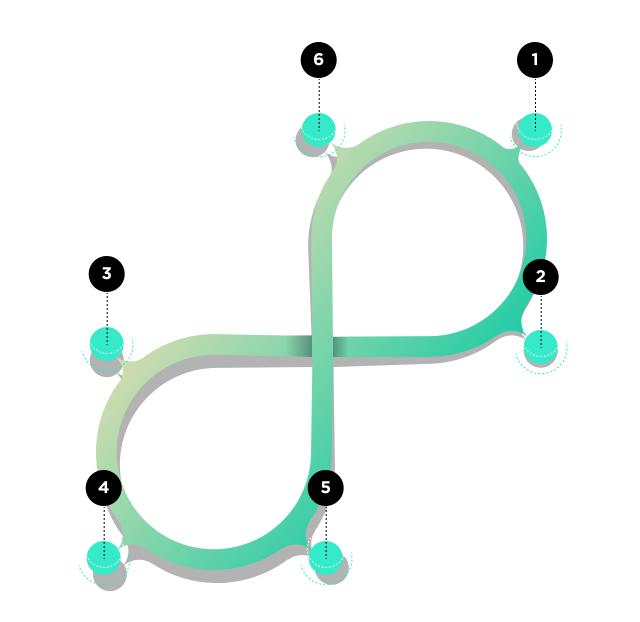
- 1 Understanding the user (Empathize)
- 2 Problem definition (Define)
- 3 Idea generation (Ideate)
- 4 Prototyping (Prototype)
- 5 Testing (Test)
- 6 Implementation (Implement)
1 - Empathize
Understanding the user
At project kickoff, we focus on a thorough understanding of the user: their habits, needs, and challenges. Through interviews, observation, usage analytics, and user journeys, we build insight into their actual experience. We complement the user context with an understanding of business objectives, existing processes, technical constraints, and system architecture. This establishes a shared foundation that enables a clear definition of what truly creates value for the user and holds strategic importance for the client.
2 - Define
Problem definition
After the research phase, we shift to defining the real challenge. Together with the client, we validate insights, assess assumptions, and determine whether we are addressing the root cause rather than just its symptoms. It often turns out that the source is not functionality, but understanding or the context of use. On this basis, we formulate a clear problem definition that connects user needs, business goals, and the technical context as the starting point for further solution exploration.
3 - Ideate
Idea generation
Once the problem is clearly defined, we move into solution exploration. The goal is to generate a broad set of ideas that go beyond the obvious answers. We put collaboration between user, business, and technical perspectives at the forefront, as this interplay often leads to innovative solutions. It is essential to create space for thinking without filtering or early critique.
4 - Prototype
Prototyping
From the selected ideas, we develop early versions of solutions. These may take the form of sketches, wireframes, or interactive mockups. The purpose of a prototype is not perfection, but to quickly turn a concept into a tangible form that we can validate with users. This reveals what works, what is unclear, and where potential technical constraints lie. Such an approach enables fast learning, fewer wrong decisions in later stages, and better alignment between user expectations and technical delivery.
5 - Test
Testing
We test prototypes in real user conditions and thus gather direct feedback. It is important that testing is not a one-off event, but part of an iterative process where user findings drive improvements. This allows us to uncover shortcomings in time, clarify ambiguities, and adapt the solution to actual needs. In doing so, we reduce risk and ensure that the final product truly delivers added value to users and the client.
6 - Implement
Implementation
Once the solution is validated and optimized based on testing, we move into the implementation phase. In collaboration with the development team, we ensure a smooth transition from prototype to final product, adhering to technical standards, security, and scalability. It is important to remain open to further improvements, as implementation is not the end, but the beginning of continuous development and adaptation based on user feedback and business needs.
Let's talk about your project.
By combining strategic thinking, high-quality design, and technological excellence, we create solutions that accelerate growth, increase efficiency, and strengthen competitiveness.
